Working together to create the construction site for &Amsterdam
An ambitious residential construction project
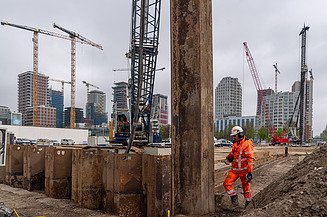
In Amstel III, the &Amsterdam residential project – one of our most ambitious construction projects – is taking shape. With a construction pit measuring no less than 8,500 m² and a volume of 40,000 m³, this project requires exceptional technical expertise and close collaboration between various parties. Consequently, it requires complex foundation and groundwater engineering techniques, involving the installation of 1,246 driven and bored piles and the use of a closed dewatering system. The collaboration on this project between ZÜBLIN and HeSto (a joint venture between Gebr. van ’t Hek and Roel van der Stoel B.V.) in partnership with Mos Grondwatertechniek B.V. is crucial to the success of this phase.
The role of ZÜBLIN
ZÜBLIN Nederland and Ed. Züblin AG are responsible for carrying out the project. Simon Denter, Senior Site Manager at Ed. Züblin AG in Stuttgart, is leading the structural works phase. Henk Sikma, environmental manager and logistics coordinator at ZÜBLIN Nederland, is responsible for liaising with the local community and coordinating logistics. Both play a key role in the project’s success thanks to their experience and close collaboration with the contractors.
Interview – A look behind the scenes at &Amsterdam
At the &Amsterdam construction site, we spoke to Gerard Waaijer (site manager at Gebr. van ’t Hek), Bram Bakker (commercial manager at Mos Grondwatertechniek, Northern Region) and Mario Zijp (project manager at Mos Grondwatertechniek, Northern Region) about the complex foundation and dewatering works. The collaboration between the parties is intensive and essential to the project’s success.
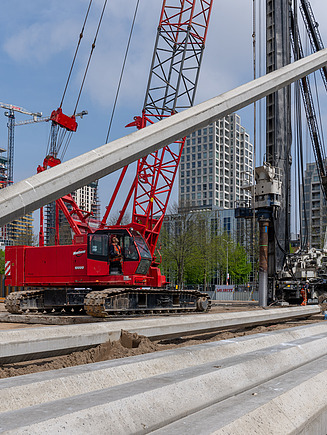
Gerard explains how it all began: “We brought in the equipment in a very tightly organised and efficient operation. Twelve lorries were required for each of the four scaffolding units. We started with the sheet piling, whilst our sister company Bodembouw worked on the CSM walls, followed by the bored and driven piles.”
Bram adds: “We have already worked on other projects in Amstel III, and the results of the pumping tests in this area have been disappointing. However, thanks to our many years of experience, we have knowledge of all kinds of soils and know what measures to take. The soil here is geologically complex and has been built up diagonally since the Ice Age, with alternating layers of sand, peat and clay,” says Bram.
Bram: “In terms of scale, we have already worked on larger projects. For example, we have carried out work for the Afsluitdijk and the Delta Works, amongst others. But for us, this is the largest project in terms of the number of wells. We have installed wells to reduce the water pressure.” Mario confirms: “We’ve been working here for two months now. Another two weeks of optimisation, and then we’ll be monitoring everything remotely.”
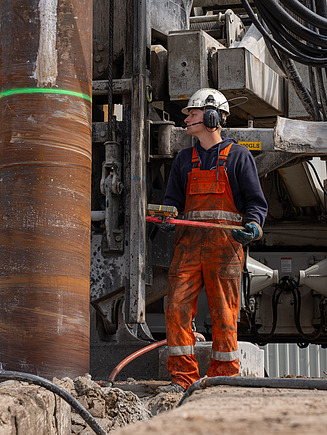
Gerard explains why a combination of driven piles and bored piles was chosen: “Bored piles are more expensive, but necessary due to the high load combined with a deep pile tip level and to limit vibrations. The piles range from 17 to 26 metres, depending on the load. The longest piles – all bored piles – are located beneath the largest tower. Reaching the correct depth with the 26-metre piles is more difficult over the final few metres.”
The shoring work is also impressive. “Linden Staalbouw, our sister company, is responsible for the so-called shoring frame between the sheet piles,” says Gerard. “They weld the tubes together here on site to a length of approximately 75 metres. That requires precision and craftsmanship.”
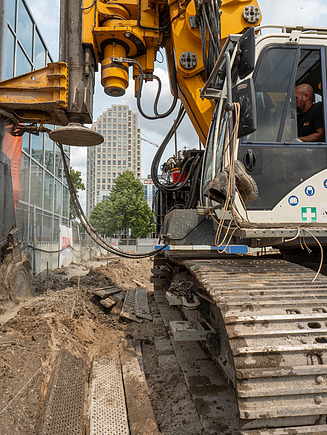
In terms of machinery, the fleet is varied: an electric pile driver, pile-driving cranes, drilling cranes, a vibratory pile driver and a compaction machine for the works carried out by Gebr. van ’t Hek.
Mos Grondwatertechniek is providing a closed dewatering system. “The water here is salty,” explains Bram. “You’re not allowed to discharge this water, because it would cause salinisation of the surface water. That’s an existing problem in the Netherlands. That’s why we’re returning it to the ground via pressure pipes.”
Mario adds: “We use online monitoring with pressure sensors. These transmit data every ten minutes. This allows us to keep the water level under perfect control. And we will continue to monitor this online until around the summer of 2026.”
Sustainability, logistics and collaboration
Sustainability is a key issue. “We use electric power wherever possible,” says Bram. “Mos is at level 3 on the CO₂ performance ladder. And we helped develop the first electric jet drilling rig in the Netherlands.” Gerard adds: “Van ’t Hek is strongly committed to sustainability. We have various electric machines. However, fully electric drilling is not yet feasible without additional investment from the client. By 2035, we’ll probably be much further along.”
For the composite piles, the return slurry was reused. The return slurry was extracted and collected in a machine that filters it, so that we can use it again. “That saves cement and is also good for the wallet,” says Gerard. “We’re ready to become even more sustainable.”
The removal of the excavated soil is a logistical feat.Gerardexplains that the sand, which is owned by the local council, is neatly returned to the council’s storage facility. The clay is transported to specialised storage sites, whilst there is also demand for the peat. In total, this amounts to no less than 40,000 cubic metres of soil, which is equivalent to around 1,300 lorries needed to transport it all. Fortunately, the location here is ideal, adds Mario: “Logistically speaking, this is a good area – you’re right next to the Amsterdam ring road.”
The collaboration between the parties is going smoothly. “HeSto always works as a single team,” says Gerard. “This was a real HeSto project. And Mos Grondwatertechniek is our regular partner for dewatering works on large and complex projects. We’ve worked with ZÜBLIN before on the Booking.com office building on Oosterdokseiland in Amsterdam, and also on the southern ring road in Groningen.” Mario adds: “Working with ZÜBLIN is a pleasure. I speak a bit of German and English with your staff, and the German staff even speak Dutch to me.”
Finally, they look ahead. “We’ve already gained a great deal of experience in this new neighbourhood. This is the third construction site,” says Bram. “Thanks to the various pumping tests, we know how the ground here can react. We’ve been in business for 125 years, so by now we know how the ground is made up and how it can react. Groundwater extraction is a broad concept, but our speciality lies in large-scale construction site dewatering.” Gerard concludes: “The project has gone well so far. There’s nothing in particular that we would have handled differently.”
-
 © Gebr. van 't Hek
 -
 © Gebr. van 't Hek
 -
 © Gebr. van 't Hek
Press contact