Van Boekel Züblin VOF is constructing the civil engineering core of the Porthos project on the Maasvlakte
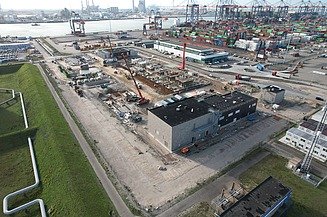
Groundbreaking climate project at the Maasvlakte
Work is in full swing at the Maasvlakte in Rotterdam on Porthos, one of Europe’s leading climate projects. This project is a collaboration between the Port of Rotterdam Authority, Gasunie and Energie Beheer Nederland (EBN).
The compressor station: the heart of the infrastructure
A key part of the infrastructure is the compressor station on the Maasvlakte. Here, the CO₂ captured by companies such as Shell, ExxonMobil, Air Products and Air Liquide is compressed, after which it is transported via a pipeline of approximately twenty kilometres to the P18-A platform at sea. From that platform, the CO₂ is injected into former gas fields, three to four kilometres below the seabed.
EBN permanently stores CO₂ from Rotterdam’s industry in depleted gas fields beneath the North Sea. This significantly reduces the amount of CO₂ entering the atmosphere and brings the 2030 climate targets a great deal closer.
Civil engineering works carried out by Van Boekel Züblin VOF
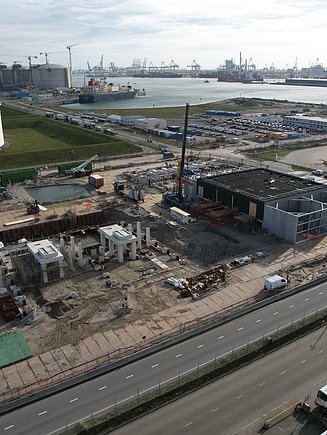
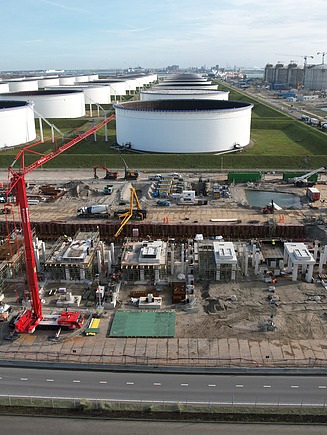
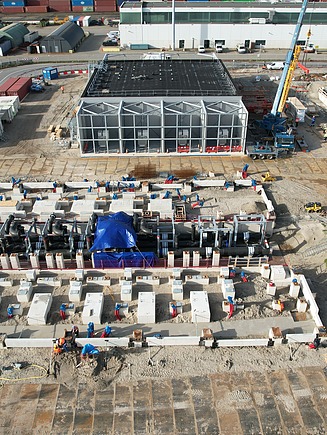
The civil engineering part of this compressor station is being carried out by Van Boekel Züblin VOF – a joint venture between Van Boekel Bouw & Infra and ZÜBLIN Nederland – as a subcontractor to the Italian contractor Bonatti. This joint venture is responsible for the architectural and civil engineering works on various buildings that form the basis for the station’s complex installations. The works are being carried out to high quality standards and within a tight schedule.
The collaboration with Bonatti and Porthos ensures that the project runs smoothly and creates a pleasant working environment.
Future-proof infrastructure for the energy transition
Construction of the compressor station began in 2024. The entire Porthos system will be capable of storing approximately 2.5 million tonnes of CO₂ annually, up to a total of 37 million tonnes. Both the Porthos onshore pipeline and the compressor station have been deliberately oversized to allow other projects to supply CO₂ in the future. The Porthos compressor station will be integrated into the Aramis CO₂ transport infrastructure and will form the central hub of the future CO₂ hub.
The compressor station is therefore a key component of an innovative, large-scale infrastructure that will play a significant role in the future development of the Port of Rotterdam and the national energy transition.
The civil engineering part of this compressor station is being carried out by Van Boekel Züblin VOF – a joint venture between Van Boekel Bouw & Infra and ZÜBLIN Nederland – as a subcontractor to the Italian contractor Bonatti. This joint venture is responsible for the architectural and civil engineering works on various buildings that form the basis for the station’s complex installations. The works are being carried out to high quality standards and within a tight schedule.
-
 © Aloys Berendsen
 -
 © Aloys Berendsen
 -
 © Aloys Berendsen
Press contact